

Sustainability Specialist: Doug Johnson
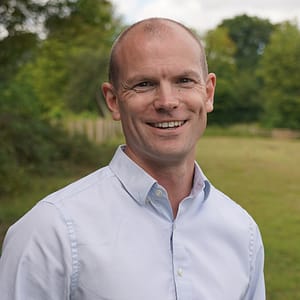
Sustainability Specialist: Doug Johnson
Sustainability specialist, Doug Johnson, is Founder of Mesh Energy – a smart renewable energy consultancy firm. He is the first 'Meshling', a chartered mechanical engineer, author and has over a decade of experience in the sustainable design and delivery of low energy buildings. Doug is also the author of ‘Right First Time’: An Architect’s Practical Guide to Planning and Delivering Low-Energy Projects.
1. What was your background prior to starting Mesh Energy?
I studied as a mechanical engineer and did a bachelors and then Masters degree at Brunel Uni in London. After having worked at a large engineering company in Havant and in parallel started a ground works contracting company on the weekends, I realized after a few years that engineering wasn’t for me. My dad had taken early retirement and he mentioned that an old colleague of his had set up a new renewable energy installation company in Norfolk. We did that together for five years and grew it to a turnover of £300K to £10M in that time. After that I did a very short stint project managing large scale solar PV farms around the UK and after having had enough of that I realized it was time to do something for me that I loved in the domestic built environment sector. Mesh was born!
2. Where did the inspiration for starting Mesh Energy come from, and what sets you apart from your competitors?
As I mentioned, I worked for a company installing renewable energy equipment back in 2008. We were selling what was profitable and what we knew. Frankly a lot of early adopter architects and clients got heavily stung and disappointed due to poor advice that wasn’t in their best interest. I set up Mesh to be holistic and independent and to help clients and design professionals to make their sustainable projects as successful as possible. Increasingly we use analytical software blended with services design (MEP) to great effect on all kinds of projects.
I know we have a massive USP besides a blended analytics and MEP offering, which is getting in early in the building design stages, before planning and helping the design team and client all the way through developed design, detailed design, construction, handover and post occupancy analysis. No other company does that, I know and the value of projects over this term is huge.
3. How did you initially obtain finance for your company?
I set aside £10k of my own money to make the business work at the start and have bootstrapped the business all the way from there. The only exception was in Jan 2020 I borrowed money for growth. Really, that was ridiculously lucky as that kept the lights on for six months as Covid hit, until our sales recovered.
4. Have you encountered any significant obstacles in your career to date? If so, how have you dealt with them?
I have officially lost count, but the “top 3” include poor management of me by managers forcing my hand in entrepreneurship and not doing enough due diligence before choosing a business partner.
The first one is easy, after continued poor management in other companies I decided I had nothing to lose. I figured a monthly salary was not worth the stress and eventually I figured that I really had no control over my destiny working for others. So, I set up my own company with what I knew! Best thing I ever did.
As for the second obstacle around partners…quite quickly after setting up Mesh I decided I ‘needed’ a business partner. I was too naive and got a partner who was easy to get on with, locally based and in the renewables industry already. He turned out be a nice guy but had no reason to work hard and he turned out to be a dead weight. It took me over two years to realise and once I dropped him the business really took off.
5. What three characteristics would you say a successful entrepreneur must have?
Absolutely the first is resilience and self-belief in what you are trying to do. Everyday is a total rollercoaster and you have to keep getting up, having had some small or large setbacks knowing that the end goal is worth it, and you will get there. Any weakness in this vision will lead to excuses, fatigue and your business failing. A great business idea can easily be trounced by lack of resilience and self-belief by the founder and likewise a mediocre idea can thrive. Persist!
I reckon the second key characteristic is the ability to start from a position of trust and build that into your team. Everyone gets the chance to prove they are not trustworthy, but starting from a position of trust is, sadly, very refreshing for most teams and they will often prove your more right than you ever thought possible. When times get tough this is key and the team will trust you!
Finally, I reckon a successful and well-balanced entrepreneur needs a distraction. Passion for your business can be all consuming and quickly turn unhealthy. Entrepreneurs have total freedom to do what they want and some kind of hobby or non-business activity you are also passionate about is key to making sure you live to see and enjoy your end goal.
6. Who do you look toward for advice and why?
I have a business coach which I have successfully used for the last five years, but I also try to keep a network of other more experienced and diverse business owners in my rolodex! I also read a lot of books and how you choose to select nuggets of information from all these sources are key to helping me form important decisions, every day.
7. Since founding the company in 2013, how have you grown your client base?
From me and a laptop and Google in 2013 we have grown on average from 2017 with a revenue of £125K (high end domestic homeowners) to this year, seeing a 100% increase in revenue growth, to £1.2M (homeowners, developers, companies and councils). We have mainly done this through education of architects and developers and following the philosophy of ‘give to receive’. It has served us well and will continue to do so well into the future.
8. What key trends do you think will impact the renewable energy consulting industry in 2023?
Net Zero carbon is becoming the new buzz word as well as some strong moves in air source heat pump technology, there is loads of juicy gossip about what large investment is going to do to the sector but let’s see. Centralised building software modelling I think will also start to be appreciated more by the sector to reach increasingly aggressive sustainability targets.
I am hoping our services will be in stronger demand than ever and that more people will realise the benefit of early-stage building performance analysis and continued support.
9. With oil and gas prices skyrocketing, do you think we will see more countries accelerating the transition to cleaner sources of energy?
No doubt. Massive divestment in oil and gas is taking place at an institutional investment level and ESG (Environmental and Sustainable Goals) are now being taken very seriously at the highest levels of business and global commerce. There is more and more data coming out that suggests decarbonization is better for economies around the globe, so smart countries will see this as a huge opportunity to grow in otherwise uncertain times.
10. Congratulations to you and the team for on your recent abseil off Spinnaker Tower! How did you find it?
I love stuff like this. I did a huge amount of rock climbing and abseiling at uni but doing it 20 years on is still really fun. It is great to do it with the team and for such an awesome local charity.
Rapid Fire:
- If you could gain a new skill instantly, what would you choose?The ability to separate time wasters from decent clients, sooner!
- What was your first job? Lawnmowing for neighbours on a ride on tractor at age 10.
- What dish do you cook the best? I bake a mean raisin, banana and cinnamon loaf.
- Are you a morning or evening person? Morning! 5am starts in the summer are simply unbeatable.
- Have you ever lived abroad? Yes, luckily my parents travelled a fair bit with work, so I saw the US for a couple of years as well as Switzerland in later years.


Cybersecurity Expert: Nicholas Powell

Cybersecurity Expert: Nicholas Powell
Cybersecurity expert, Nick is Founder of Erika - an online safety technology that safeguards the digital wellbeing of employees and their families by protecting them from people who mean them harm online (protection from online fraud and child grooming) and by providing user support to internet addiction. Erika is made available as an employee benefit through HR departments as part of an employee digital wellbeing programme.
1. What was your background to setting up Erika?
My personal background is in Risk Management. After graduating from University, I served in the British Army for 7 years before setting up an Information Security consultancy, which I ran for five years serving UK and US businesses. Always wanting to get into the tech sector, I used my time consulting to develop thoughts to online safety & security problems that could be solved with technology. When my consulting conversations were put on pause during COVID, it gave me the push to build the engineering team and start our journey with Erika. There was no better use of time during lockdown to grab a blank sheet of paper and to start innovating.
2. Where did you get the idea for your business and what sets you apart from your competitors within the cybersecurity market?
Our Personal Online Safety & Security is integral to the security of the businesses we work for, our own digital wellbeing and the wellbeing of our family – and yet is an area that I saw as under-served by technology – particularly in combatting the rising threat of online fraud, scams and child grooming done through social engineering; and so it is this problem that we serve. I also recognised that businesses have an interest and role to play in helping their employees and their families stay safe online, to maintain wellbeing, productivity and happiness in the workplace and so Erika is uniquely made available as an employee benefit through HR departments as part of employee wellness programmes.

3. Did you experience any challenges at the beginning of your journey? If so, how did you overcome them?
The start-up journey has daily challenges. Finding a gap, building a product to serve that gap and going to market is by its very nature, hard. One early unforeseen challenge that we faced in product development was a cultural one – we knew that the key to building something that people wanted was to build an MVP, stay lean and speak with the end user to get feedback and iterate. Our first focus was to protect users from online fraud. We hypothesised that our most loyal users would be those who have already fallen victim to fraud – all we needed to do was to find them and talk to them. We quickly learned however that people who were victims of online fraud don’t like talking about it – they are embarrassed and don’t step forward to speak about their experiences. This gave us challenge from an early product perspective and we had to resolve it by using fraud statistics and expertise to build from – who was being scammed the most and how. We’ve since expanded the product offering to support employees with family and child online safety, where users (parents) are much more willing to have a conversation about their thoughts and needs in the topic, giving us a stronger basis for iteration.
It’s also true what they say about the team being the most important part of a start-up and why you read that investors look at team first and foremost and product/market thereafter – they know that your first product idea or hypothesis is likely to be challenged, but with a first-class team you can overcome the unexpected.
4. Do you currently have any other additional business opportunities or ideas that you are passionate about?
We want to be the leaders in online safety & security for employees and their families and we have a product roadmap and strategy to achieve that. This will be our mission for the years ahead.
5. What do you enjoy most about working for yourself?
By its very definition entrepreneurship is all about creating something new, creating your own rules and changing the norm. It’s hard but it gives you fulfilment and satisfaction that cannot be matched.
6. How would your colleagues describe your management style?
Ha, mmmm – well from my Army days I would like to say I lead from the front. In the office the team would likely say I have a fair approach – fairly relaxed but that I micro-manage probably a bit too much! It’s a very hard balance when you are in the early stages of start-up to be the custodian of investors’ money but at the same time wanting to give the team free reign over their department. If you go off course, it’s me who is accountable as CEO but at the same time you want the team to have freedom of action and thought. It’s a tough balance I have yet to master.
7. What strategies did you initially employ to promote your cybersecurity business?
At its core Erika is a consumer product, and so a direct-to-consumer marketing strategy is perhaps an obvious route to market – but D2C it’s expensive and attritional. We instead recognised that businesses were being impacted by the personal online safety & security of their employees and making Erika available as an employee benefit as part of HR wellness programmes, was the quickest and most valuable route to market. Digital wellbeing will increasingly become a critical aspect of employee Personal wellbeing and it’s this growth area that we serve.

8. Do you think there will be many changes within your current sector in the next 10 years, and how do you envision the future for Erika?
In addition to safeguarding the Digital Wellbeing of employees for their personal health and productivity, the personal digital assets of employees and their families are now and will become ever more, a critical component of enterprise security. Here, hackers will increasingly seek to profile and target employees on their personal accounts and online channels, to subvert and penetrate the businesses they work for and is a risk amplified by the work from home environment, that has readily crossed and muddied our personal online workflows with our business workflows. The future of enterprise defence will therefore require Info Sec teams to extend resources towards tools like Erika, that serve the business ‘beyond the gate’ that protect the individual and their families.
9. If you could offer a first-time entrepreneur only one piece of advice, what would it be?
Not to be afraid of failing. You can only learn by failing – so fail fast, learn and iterate. I am very critical of the ‘British way’ that does not readily allow others to try new things for fear of failure or judgement. Testing hypotheses and finding product market fit can ONLY be achieved by failing fast. So, embrace failure, learn, iterate and succeed.
Rapid Fire
- Name a person that inspires you. – Phil Knight. A cliché perhaps but read Shoe Dog and you’ll join the club.
- What’s the best meal you have ever eaten in a restaurant? – An Army ration pack on Sennybridge training area in Wales. Al fresco dining at its best after a hard day at the office.
- Are you more of a morning person or a night owl? – Definitely a morning person. I have two boys under the age of two – I am a morning person.
- What is one thing about you most people don’t know? – That I’m one day going to get my CTO to teach me how to code (don’t tell him – it could break him).
- What is your best childhood memory? – The Indiana Jones ride at Disney World, Florida, aged 9.

The Rise and Rise of Direct Investment
The Rise and Rise of Direct Investment
The boom in private equity has historically been driven by traditional “blind pool” private equity funds. This remains very popular and is a well-trodden path with demonstrable success. However, in recent years, across the international investment landscape we have seen a huge increase in the number of “deal-by-deal” PE managers providing access to direct investments in target companies to their investors.
Some deal-by-deal operators have emerged out of necessity, where they have been unable to raise a traditional blind pool fund. However, others entered the fray to either serve an investor base with an appetite for greater control over their investment decision making (and risk), or indeed to address deals, and/or deal structures, that traditional PE funds cannot fulfil, or deliver on.
Investors are allocating an increasing portion of their private equity commitments to direct investing, backing what, in the US, is referred to as a “fundless sponsor”. Here in the UK, we have seen a number of market entrants successfully provide investors with access to lower-mid-market and mid-market deals on a deal-by-deal basis over the last decade.
Years ago, we identified that certain investors, particularly the more private investors such as family offices, and Ultra-High/High Net Worths, have fluctuating liquidity (which is a factor), and also wanted to have greater control over the investments they choose to get involved in. Deal-by-deal sought to address this, allowing them to pick and choose when to participate to suit their own cashflows and their investment appetite at the time.
However, over the years, what also became clear was that having total flexibility, unencumbered by the traditional PE fund “rules” (set out in the fund investment agreement with LPs) meant being able to be more creative about deals. Its less a case of having to force our square peg into someone else’s round hole – need high yield debt or fixed return preferred equity?… no problem, need minority investment for an eight-year hold period?… no problem – the fact is the investors themselves get to decide what works for them in a given scenario, which makes the deal-by-deal operator more flexible.
This works the same way with sector limitations too. We recently had a business on our desk involved in defence (a sector which for obvious reasons is in a current period of strong growth) – which the PE funds had universally declined based on ESG concerns, and in most cases forbidden by the “rules” of the Fund. Not bound by these same limitations, a deal-by-deal operator can consider a deal like this and leave it to investors to determine whether they wish to participate in it. The end investor can take their own view on the ESG matter, rather than having a blanket approach. This could be the same in a plastics business, a sex toy business, or a CBD products business, all of which have crossed our desk with the same problem for blind pool PE funds.
And certainly, the rise of the direct investment class has brought a whole new generation of investors into the asset class. Where private equity would historically have been the domain of institutions and the super wealthy, some managers have made it possible for investors to participate in deals for a few thousand pounds. This provides access to a whole new cohort of investors, which some would argue is increasingly democratising the asset class. Some deal-by-deal operators have investor databases which run into thousands of names.
Investors have also told us that they like that, as a deal-by-deal manager, we are more aligned with their interests because our economics come from co-investment in sweet equity – we sit in the same instruments as our investors. We don’t need to “trigger carry” in a fund or sell businesses at a sub-optimum moment to provide the exit credentials needed during the fundraise for the next fund. We sit alongside our investors maximising returns for them on a specific asset – and investors seem to like that. Added to which, deal fees are also deal-specific – investors tell us this is preferred rather than the AUM fees of a traditional fund. That said, we do see some deal-by-deal operators charging comparatively high deal fees, but like all things this will have a way of finding its market norm (much like it has for traditional funds).
There are undoubtedly pros and cons for both the model of a traditional fund and the deal-by-deal model, but both are here to stay and the continued growth of the latter may provide new tools and opportunities for vendors, shareholders, management teams and intermediaries on deals, and with that, greater opportunity for a wider and deeper pool of investors. Interesting times indeed!
Further Information
Del Huse is Founder and CEO of deal-by-deal investor Roycian Ltd. www.roycian.com
Bluebox Velocity was created in the depths of ‘Lockdown 2020’ by an exceptional team of world-class developers and techies alongside professionals with more than 100 years of combined experience in mid-market Mergers and Acquisitions. It sits seamlessly alongside Bluebox Capital, founded in 2022.
Bluebox Capital is a leading early-stage investment organisation supporting high-growth, UK-based businesses across all sectors, with cheque sizes of between £50,000-£250,000 of capital as well as guidance and expertise.